

7 Ways to Zone an Open-Plan Kitchen Living Room

Open-plan spaces look great in estate agent photos. In practice, they take a bit more thought. Without walls to do the organising for you, one large room can easily start to feel like it doesn't quite know what it's for — part kitchen, part living room, part corridor, with no zone feeling properly resolved.
The good news is that zoning doesn't require structural work. Furniture, rugs, lighting, and a few considered layout decisions can create distinct areas within the same footprint. Here's how to approach it.
1. Use your sofa as a room divider
The sofa is the most effective zoning tool in an open-plan space, and most people underuse it. Rather than pushing it against a wall, float it in the room with its back facing the kitchen or dining area. This creates a clear visual boundary between the living zone and the rest of the space — without blocking light or sightlines.
A corner sofa works particularly well here. The L or U-shape creates a natural enclosure that signals "this is the sitting area" without needing anything else to define it. In larger open-plan rooms, this approach can single-handedly anchor the whole layout.
Can you use a sofa to divide a room?
Yes — and in open-plan spaces, it's one of the most practical ways to do it. Floating your sofa away from the wall creates a zone boundary while keeping the space feeling open. The back of the sofa acts as a low visual divider that separates areas without blocking light.
For flexible arrangements that can be reconfigured as your space evolves, a modular sofa gives you the most options — you can expand, reduce, or reshape it to suit.
2. Define zones with rugs
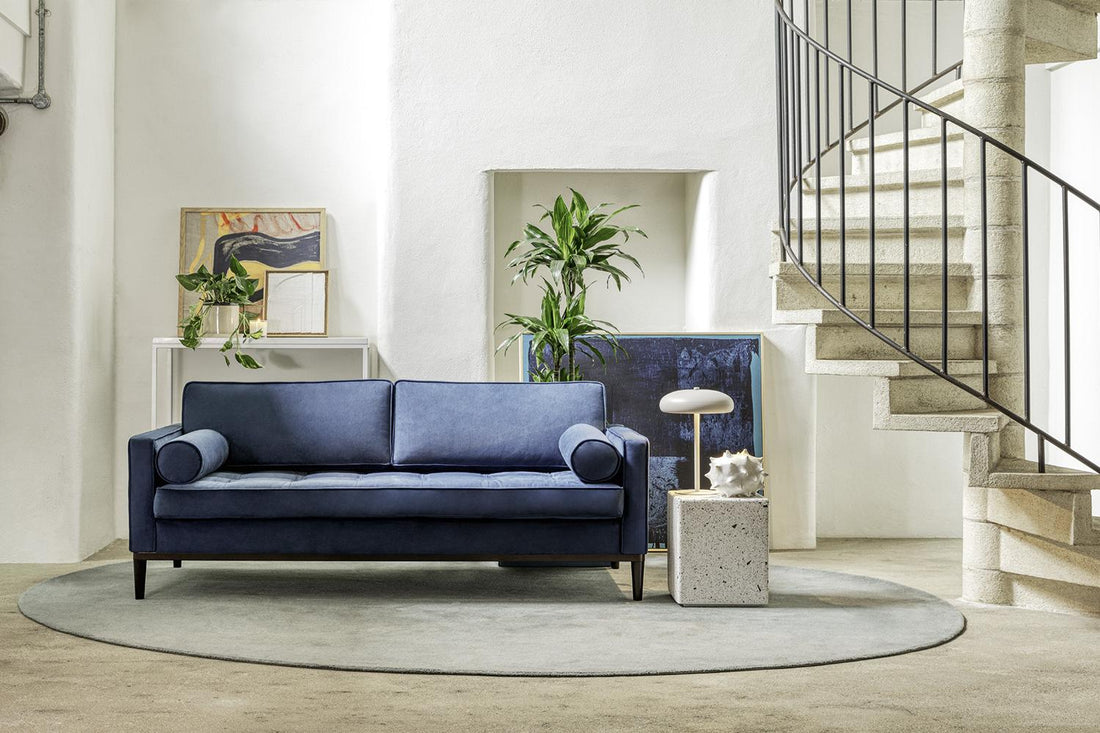
A rug does more spatial work in an open-plan room than almost anything else. Place one under your sofa and coffee table and it immediately creates a bounded living area — even if there's nothing else around it. The rug tells you where one zone ends and open floor begins.
The key is scale. In an open-plan space, rugs that are too small look like they've been randomly placed on the floor. The rug should be large enough that at least the front legs of the sofa sit on it — ideally all four. This grounds the furniture and makes the living zone feel intentional rather than incidental.
In a combined kitchen-dining-living space, two rugs — one under the dining table and one in the sitting area — can do most of the zoning work on their own.
How big should a rug be in an open-plan room?
Bigger than you think. For a sofa arrangement, aim for a rug large enough that the front two legs of each seat sit on it, or go larger so all the furniture sits fully on the rug. A rug that's too small will make the zone feel less defined, not more.

3. Arrange furniture to face inward
In a contained living room, it doesn't matter much which way the furniture faces — the room itself provides the boundary. In an open-plan space, you need the furniture arrangement to do that job instead.
Facing all the seating inward — toward a central coffee table or focal point — creates a conversation-friendly layout that feels like a room within a room. Avoid having chairs or sofas facing outward toward the kitchen or a hallway, as this breaks the sense of enclosure and makes the zone feel undefined.
Arranging two sofas facing each other is one of the most effective layouts for open-plan living rooms. It creates a clear social zone with a defined centre, and the symmetry helps the area feel settled and purposeful.
How do you arrange furniture in an open-plan room? Face all seating inward toward a central point — a coffee table, a rug, or a focal feature. This creates a self-contained zone rather than seating that drifts toward the edges of the space.
4. Create a visual break with a console or shelving unit
If you want a more defined boundary between zones without using a full partition wall, a low console table, open shelving unit, or sideboard placed behind the sofa creates a transition point between areas. It's not a wall — light and air move freely around it — but it gives the eye something to read as a boundary.
This works particularly well between a living zone and a dining area. A waist-height unit placed perpendicular to the main traffic flow signals a change of zone without interrupting the flow of the room.
As a bonus, the surface behind the sofa becomes useful — somewhere to put a lamp, a plant, or a few books, which adds warmth to what can otherwise feel like a large, undifferentiated space.
5. Use lighting to separate areas
Lighting is one of the most overlooked zoning tools in open-plan spaces, and one of the most effective. A pendant light hung directly above a dining table creates an immediate zone — the light draws the eye down and anchors the table beneath it. A floor lamp in a corner of the sitting area does the same, creating a pool of light that defines the space around it.
In a large open-plan room, the goal is to avoid one even wash of overhead light that treats the whole space as a single undifferentiated area. Instead, use layered lighting — a mix of pendants, floor lamps, and table lamps positioned within each zone — so that each area has its own light source and its own atmosphere.
This becomes especially useful in the evenings. Turning off the kitchen lights and switching on lamps in the sitting area effectively collapses the perceived size of the room to just the living zone, making a large open-plan space feel more intimate when you want it to.
Does lighting help with zoning in open-plan spaces? Yes. A pendant above a dining table, a floor lamp in the living area, and task lighting in the kitchen each mark out their zones visually. Lighting lets you switch which zone feels active at any given time, simply by changing what's switched on.
6. Use colour or texture to distinguish zones
You don't need to paint the whole room different colours to create a sense of distinction between zones. Softer approaches — a different wall treatment on the kitchen side, a distinctive rug texture in the living area, upholstered dining chairs in a contrasting fabric to the sofa — all contribute to a sense that each zone has its own character without breaking the visual flow of the room.
In smaller open-plan spaces, restraint matters here. Two or three zones working with the same broad palette but with subtly different textures or accent colours will feel more considered than sharply contrasting colours that make the room feel chopped up.
Cushions and throws on the sofa are an easy way to introduce a colour or texture note that distinguishes the living zone from the dining or kitchen areas, without any commitment.
7. Let a focal point anchor each zone
Every zone in an open-plan room benefits from having something to orientate around — a focal point that tells you what the space is for. In the living area, this is usually the TV or a fireplace. In the dining area, it's the table. In a reading corner, it might be a floor lamp and a well-placed armchair.
The mistake in many open-plan spaces is to have one strong focal point — usually the TV — that the entire room is oriented around, which means the dining area ends up feeling like an afterthought. Giving each zone its own focal feature, even a modest one, makes each area feel purposeful.
If the living zone lacks an obvious architectural focal point, a piece of wall art, a large plant, or a well-styled shelving unit can do the same job. The eye needs somewhere to land in each zone — without it, the space just feels large and unresolved.
What makes an open-plan room feel smaller or cosier? Defining each zone clearly with rugs, furniture arrangement, and focused lighting makes a large open-plan space feel warmer and more liveable. Using corners effectively within each zone adds intimacy without reducing the overall sense of space.


