

Living Room Colour Ideas: How to Make Your Space Feel Lighter for Summer

Living Room Colour Ideas: How to Make Your Space Feel Lighter for Summer
Most living rooms spend winter looking exactly as they should: warm, layered, slightly dark around the edges. That works from October to March. By May, the same room can start to feel like it needs the curtains opened and most of the throws put away.
Making a living room feel lighter for summer does not require redecorating. In most cases it does not even require painting. The changes that have the most impact tend to be the ones that cost the least: shifting colours, swapping out soft furnishings, rethinking light. This guide covers the practical options, starting with the ones that are easiest to reverse.
Start with what you already have: declutter and edit
Before anything else, the most effective way to make a living room feel lighter is to take things out. A living room that has accumulated throws, cushions, side tables, and decorative objects over winter will naturally feel heavier and more enclosed than the same room with half the stuff in it.
The edit does not need to be permanent. Box up the heavier, darker textiles and store them until autumn. Clear any surfaces that have become landing spots for objects that do not belong there. Move furniture away from windows so natural light reaches further into the room. These are free, reversible, and effective.
Only once you have cleared the room down to its baseline is it worth thinking about what to add or change.
Living room colour ideas for a lighter feel
Colour is the highest-impact change you can make to a living room, and also the most committed. If you are repainting, it is worth understanding what actually makes a room feel light before choosing a shade.
It is not just about how pale the colour is. Undertone matters more than depth. A warm off-white with a yellow undertone will feel lighter and more alive than a cool white with a blue or grey base, even if the cool white is technically lighter on a paint swatch. The same applies across all colours. Warm undertones reflect light in a way that reads as brightness; cool undertones can feel flat even when they are pale.
The colours that reliably make living rooms feel lighter and more open:
Warm whites and off-whites are the most reliable choice and the easiest to work with. Not brilliant white, which can read cold and clinical in the wrong light, but a white with a hint of cream, stone, or yellow. Farrow & Ball's All White, Dulux's Timeless, and Little Greene's Blanc are all widely used examples in the UK. These shades work in every room orientation and with virtually every sofa colour.
Soft warm neutrals in pale stone, warm putty, and greige sit just above white on the warmth scale and give a room more character without making it feel heavier. A good choice for rooms that already have warm wood floors or natural fibre rugs, where a stark white might feel disconnected.
Pale sage and soft green are cool enough to feel fresh without being harsh, and warm enough to avoid the cold quality of a blue-grey. Particularly effective in rooms that face a garden, where the colour picks up the outdoor tones. A pale sage living room wall with natural linen or cream soft furnishings is one of the most consistently successful summer combinations.
Pale blue and sky blue are genuinely light-lifting colours in the right room. Best in south or west-facing rooms where the warmth of the afternoon light balances the coolness of the blue. In north-facing rooms, a pale blue can read chilly rather than airy, and a warm neutral is the safer option.
Warm yellows and terracotta are less obvious choices for a "light" scheme, but warm saturated colours borrow light in a way that cooler, paler shades do not. A soft warm yellow in a bright room creates energy and openness. Worth considering if you want something beyond the standard neutral palette.
What to avoid: Cool greys, blue-greys, and anything with a distinctly green-grey undertone tend to flatten a room in British summer light. They work well in winter schemes but often look heavier in the longer, brighter days. If your living room currently has cool grey walls and feels oppressive in summer, that is likely the reason.
The fastest living room refresh: swap your soft furnishings
If painting is not an option, whether due to a rented home, recent redecoration, or not enough time, soft furnishings do more work than most people expect. Cushions, throws, and rugs all add visual weight and temperature to a room. The dark, heavy versions you needed in January are actively working against you in June.
The summer swap is simple: lighter fabrics, lighter colours, fewer pieces overall.
Cushions: Replace velvet or heavily textured cushions with linen, cotton, or boucle in warm whites, soft greens, dusty pink, or terracotta. You do not need many. Three cushions that are well-chosen do more than seven that are fighting each other. Swyft's cushion range includes a range of colours and textures suited to seasonal swaps.
Throws: Pack away the heavy wool or chunky knit throws. Replace with a linen or cotton throw in a neutral or warm tone, something that adds texture without adding warmth. Draped loosely over a sofa arm rather than folded over the back, a lighter throw reads as decorative rather than functional, which is exactly the tone you want in summer.
Rugs: If you have a large, dark rug anchoring the room, consider whether it still earns its place in the warmer months. A natural fibre rug in jute, seagrass, or sisal is the easiest summer swap. It adds texture without adding colour or visual weight, and it works with virtually every sofa colour. Alternatively, a flatwoven rug in a lighter neutral has the same effect.
Sofa: If your sofa is a darker shade and the room feels heavy as a result, consider whether the issue is the sofa or everything around it. Often the sofa is fine. It is the accumulation of dark textiles and low light around it that creates the heaviness. Stripping the room back and adding a lighter rug and cushions will often change how the sofa reads without any need to replace it. If you are considering a new sofa with summer in mind, a cream, stone, or linen-toned fabric will make the most consistent contribution to a lighter room year-round. Browse Swyft cream sofas and light grey sofas for options that suit a brighter palette.

How to use light to make a living room feel bigger and brighter
Colour and soft furnishings make a difference, but light is what actually determines how a room feels to be in. Most living rooms in the UK are not making the most of the natural light they have.
Maximise what you already have. Furniture placed in front of windows blocks light before it reaches the room. If your sofa backs up against a window, consider whether it can be repositioned. Even a few inches can make a difference. Avoid placing tall shelving or storage units adjacent to windows where they create a shadow across the room.
Curtains and blinds. Heavy lined curtains that are only half-drawn block a significant amount of light even when they are technically open. For summer, consider replacing them with a lighter fabric, such as linen or voile, that diffuses rather than blocks. If replacing curtains is not practical, make sure the existing ones are drawn fully back past the window frame rather than sitting partially across it. Our guide to window dressing ideas for living rooms covers the full range of options.
The direction your room faces matters here. South and west-facing rooms get strong afternoon and evening light and can handle heavier fabrics more easily. North-facing rooms receive cooler, more diffuse light all day and benefit most from maximising every source. Lighter walls, lighter curtains, and strategically placed mirrors all help.
Mirrors. A large mirror placed opposite a window reflects light back across the room and creates a genuine sense of additional depth and brightness. This is one of the oldest interior design tricks and one of the most effective. It works best when the mirror reflects either the window itself or a part of the room that has good light, not a dark wall or a corner that gets no natural light.
Artificial light. The overhead light, often called the "big light", is the enemy of a comfortable, airy living room. It creates flat, shadowless illumination that makes a room feel utilitarian rather than warm. In summer, when natural light is abundant during the day, this matters less. But for evenings, a combination of table lamps and floor lamps at different heights creates a layered light quality that feels much more considered. Our living room lamps guide covers this in detail.

Colour schemes that work for a summer living room
If you are starting from scratch or planning a full refresh, the following combinations consistently work for a lighter summer feel in UK living rooms.
Warm white walls, natural linen sofa, jute rug. The classic neutral scheme. Completely seasonal-neutral but feels particularly at home in summer when the light is at its best. Add cushions in terracotta, sage, or dusty rose to bring warmth without heaviness.
Pale sage walls, cream sofa, warm wood. A fresh, nature-adjacent palette that works particularly well in rooms with garden views or south-facing aspects. Oak, walnut, and rattan all complement sage well. Keep accessories in warm neutrals rather than adding more green.
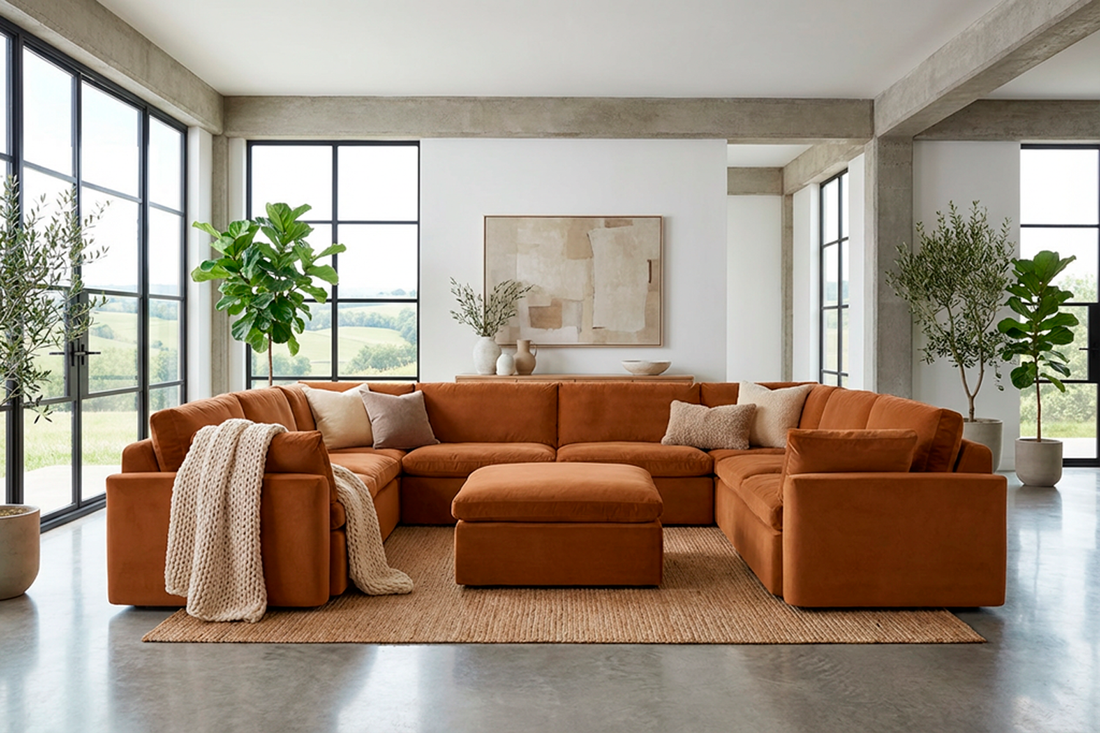
Off-white walls, a colour sofa, stripped-back accessories. If you have a statement sofa in forest green, burnt orange, or a deep blue, the summer version of that room is the same sofa with lighter, simpler everything else around it. White walls, fewer cushions, a natural rug, linen curtains. Let the sofa do the work.
Warm stone or putty walls, neutral sofa, brass accents. Warmer than the white palette but still light and open. Brass or warm gold metallic accents reflect light effectively without adding colour. Works particularly well in older homes or rooms with period features where stark white can feel incongruous.
Plants and natural elements
One summer change that costs very little and has a disproportionate effect: plants. A well-placed large-leafed plant such as a monstera, a fiddle-leaf fig, or a palm adds height, movement, and the outdoor quality that makes a room feel fresh without requiring any structural changes. In a room with a green or sage sofa, indoor plants make a natural companion. In a room with warm neutrals, they add the only green in the room, which tends to be exactly enough.
Beyond plants, natural materials introduced through accessories such as woven baskets, ceramic pots, wooden bowls, and rattan lampshades bring texture and organic warmth that reads as summer-appropriate without needing to be explicitly decorative.

Frequently asked questions
What is the best wall colour to make a living room feel lighter? Warm whites and off-whites are the most reliable choice. The key is choosing a shade with a warm undertone, such as cream, stone, or yellow, rather than a cool or blue-toned white, which can feel flat in British natural light. Pale sage and soft warm greens are strong alternatives if you want something with more character. For a full breakdown of options, our guide to best paint colours to make your room look bigger covers undertone and orientation in more detail.
Does a light or dark sofa make a room feel lighter? A lighter sofa does contribute to a lighter overall room, particularly in smaller spaces or rooms with limited natural light. But the relationship is not as straightforward as light sofa equals light room. A dark sofa in a room with white walls, light curtains, and well-chosen accessories can feel entirely open and airy. A light sofa surrounded by heavy textiles and low lighting can still feel oppressive. The room needs to work as a whole. See our guide on whether your sofa should be lighter or darker than your walls for more on this.
What colours make a small living room feel bigger in summer? Warm whites, off-whites, and pale warm neutrals are the most effective. Pale sage and sky blue work well in rooms with good natural light. The principle that matters most is undertone. Warm undertones reflect light and feel open; cool undertones can feel contracting even when the shade is pale. Avoid cool greys in summer, which tend to flatten rather than open a room. More on this in our best colours for small living rooms guide.
How do I refresh my living room for summer without spending much? The highest-impact low-cost changes are editing down what is in the room, swapping dark or heavy textiles for lighter ones, and improving how natural light moves through the space. This means repositioning furniture away from windows, drawing curtains fully back, and adding a mirror opposite the main window. New cushions and a natural fibre rug are the most cost-effective additions. A full repaint is not necessary unless the wall colour is genuinely working against the room.
Do I need to repaint to make my living room feel lighter? Not necessarily. If the existing wall colour has a warm undertone, it may feel perfectly appropriate for summer with only changes to soft furnishings and light management. If the walls are a cool grey, deep blue-grey, or anything with a distinctly cold quality, repainting will make a significant difference that no amount of lighter cushions can replicate. In that case it is worth doing.
What fabric sofa is best for a summer living room? Linen and cotton fabrics are the most naturally summer-appropriate, with a breathable, casual quality that reads as fresh. Boucle in lighter tones works well for the same reason. Velvet is a more winter-leaning fabric; in a darker shade it can make a room feel heavier in summer, though a velvet sofa in a light cream or warm stone can still work well. Swyft offers a range of linen sofas and lighter fabric options suited to a summer palette.
If you are refreshing your living room for summer, start with the free changes: declutter, reposition furniture, maximise light. The room you end up with after those edits often needs far less than you thought.
Browse the full Swyft sofa collection or order free fabric swatches to find a colour and fabric that works year-round.
For more on living room colour decisions, see our guides to choosing sofa colours, best colours for small living rooms, and how to keep your home cool in summer.


