

Bedroom Wall Ideas: 8 Ways to Fill a Blank Wall That Actually Work
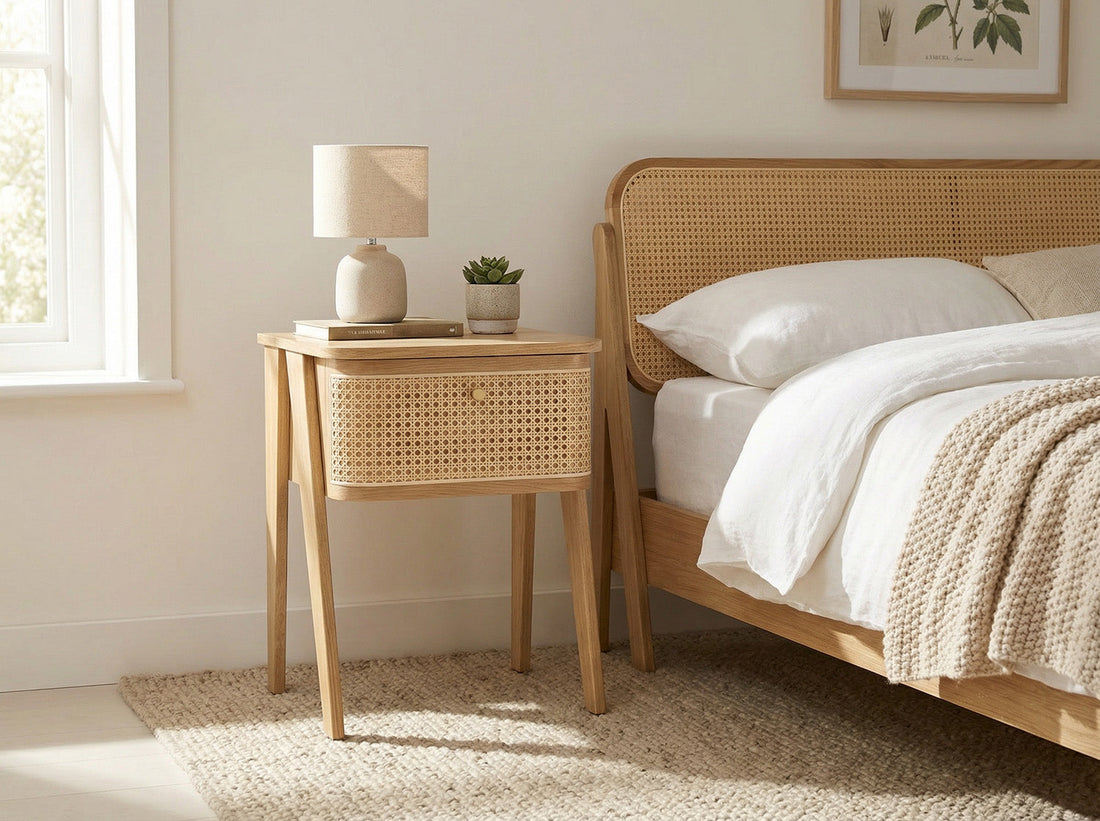
Bedroom Wall Ideas: 8 Ways to Fill a Blank Wall That Actually Work
A blank bedroom wall is one of those problems that's easy to overthink and difficult to start. The options are almost limitless, which tends to produce either paralysis or a series of half-committed attempts that never quite land.
The ideas below are practical starting points, ordered by impact. Each one works on its own; most can be combined. The goal in every case is a wall that feels considered rather than decorated for its own sake.
1. Start with the bed wall, and everything else follows
The wall behind the bed is the most important surface in the bedroom. It's what you see when you walk in, what appears in every photograph, and what sets the visual tone for the rest of the room. Getting this wall right makes the others easier; leaving it blank while you decorate elsewhere tends to leave the room feeling unfinished regardless of what else you've done.
The bed itself anchors this wall. Before adding anything to the surface, make sure the bed is centred and that the headboard is doing its job. An upholstered headboard with height and presence can be enough on its own a statement piece in a strong colour or a well-proportioned winged headboard reads as a deliberate design choice rather than an empty wall. Swyft's Bed 02, with its upholstered winged headboard, is built precisely for this: the headboard fills the wall space above and behind the bed without needing anything else to compete with it.
If the headboard is lower or more minimal, the wall above it becomes active space that benefits from some treatment: art, a panel, a mirror, or a paint technique. The decision depends on what the headboard is doing and how much visual weight the wall needs.
One practical note: whatever goes on the bed wall should be centred on the bed, not on the wall itself, unless the two happen to align. A piece of art hung at window-centre rather than bed-centre always looks slightly off, even when it's technically symmetrical.

2. A large mirror does more work than most people expect
A well-placed large mirror on a bedroom wall solves several problems simultaneously. It makes the room feel bigger, reflects light from windows or lamps, and adds a decorative element that works in almost any interior style. It also happens to be one of the most functional things you can put on a wall. Useful for getting dressed, for checking proportions, for bouncing natural light deeper into a north-facing room.
The sizing rule is the same as with art: go larger than your instinct suggests. A mirror that's too small for the wall reads as timid; one that's properly scaled reads as intentional. On a wall beside or opposite the bed, a full-length mirror leant against the wall (rather than hung) adds a relaxed, considered quality that feels less formal than a mounted piece.
A mirror is also a good solution for a wall that does not get much else: the space beside a wardrobe, the narrow wall between a door and a window, or an alcove that is not deep enough for shelving. It fills the space without crowding it.
3. A gallery wall works best with a constraint
Gallery walls are one of the most searched bedroom wall ideas, and one of the most commonly executed poorly. The most typical mistake is buying a collection of different-sized frames in different finishes, spacing them by feel, and ending up with something that looks unplanned in the wrong way.
A gallery wall works when it has at least one consistent element running through it. That might be a single frame colour (all black, all natural wood, all white), a consistent mat width, a defined shape for the overall arrangement (a grid, a horizontal row, a rectangular block), or a consistent theme in the images themselves. Mixing frame sizes within those constraints reads as curated; mixing everything reads as random.
Before committing nails to the wall, lay the arrangement out on the floor. Photograph it. If it looks cohesive in a photo, it will look cohesive on the wall.
Above the bed, a gallery wall that extends no wider than the headboard and no higher than roughly a metre above it tends to work best. Going wider than the bed makes the wall feel busy; going too high disconnects the arrangement from the furniture below it.
4. Shelving that's styled, not just stored
A shelf on a bedroom wall is primarily a storage solution. The reason it also functions as wall decor is that the objects on it become the visual element. The shelf is just the structure that holds them.
This distinction matters because it changes how you approach the shelf. A shelf packed with books, chargers, and miscellaneous items is storage. A shelf with three or four objects chosen for their shape, texture, and relationship to each other is a decoration. Most bedroom shelves end up somewhere between the two, which is fine, but the decorative ones tend to have a stricter edit and a more considered arrangement.
For a shelf beside or above a bed, keep it at a height that makes practical sense (reachable from a seated or lying position for a bedside shelf, or clearly above head height for a purely decorative one). A floating shelf with a few well-chosen objects, a plant, a candle, a small stack of books, and a lamp on the surface below creates a layered, considered arrangement that makes the wall feel active without being crowded.
Bedside tables serve a similar anchoring function on either side of the bed. Swyft's bedside tables pair with the upholstered bed range and create a grounded, symmetrical arrangement that gives the bed wall structure even before anything is hung above.

5. Panelling and paint: the case for treating the wall itself as the feature
Not everything that goes on a wall needs to be hung or leant. Treating the wall surface itself through paint, panelling, or wallpaper is often the most impactful change you can make to a bedroom, and in many cases makes everything else unnecessary.
A painted panel behind the bed (a rectangle of colour that frames the headboard, running from floor to ceiling or just above the bed) creates a feature wall effect without requiring wallpaper or a full room repaint. It's easy to execute, straightforward to change, and gives the room a considered quality that scattered art often doesn't.
Vertical panelling, whether real timber battens or MDF strips painted to match the wall, adds texture and architectural interest to a flat surface. It works particularly well in bedrooms where the walls are plain and the furniture is simple. The panelling does the decorative work so nothing else has to.
If you're considering wallpaper, a single wall behind the bed is usually the right scope. A full room of pattern in a bedroom can feel overwhelming; a single feature wall lets the paper make an impact without dominating the space.
6. One large piece of art beats several small ones
The instinct when facing a blank wall is to fill it proportionally. A large wall gets several pieces, a small wall gets one or two. In practice, the opposite approach tends to work better: one well-chosen large piece almost always looks more resolved than a collection of smaller ones, regardless of the wall size.
A large piece of art (or a print, photograph, or textile; the format matters less than the scale) gives the wall a clear focal point. It's also significantly easier to hang and arrange than a multi-piece grouping, and easier to change if you want something different later.
The practical guide for sizing art above a bed: the piece should be roughly two-thirds the width of the headboard. Any wider and it competes with the bed; any narrower and it floats awkwardly above it. Height-wise, leave a gap of roughly 15–20cm between the top of the headboard and the bottom of the frame.
For a wall that isn't the bed wall, a large piece of art anchored by a piece of furniture below it, a chest of drawers, a chair, or a low shelf, creates a composed arrangement that reads as intentional.

7. Lighting on the wall, not just from the ceiling
Bedroom lighting is typically ceiling-led, which produces an even but flat quality of light that's practical and uninspiring. Adding a light source on the wall, whether a wall-mounted reading light, a sconce, or a pendant hung from a ceiling rose at wall height, changes the atmosphere of the room significantly and also counts as one of the more visually interesting things you can put on a blank surface.
Wall-mounted bedside lights are particularly useful in bedrooms where the bedside table is small or non-existent. They free up surface space, keep cables tidier, and give the bed wall a finished, hotel-like quality that freestanding lamps don't always achieve.
If rewiring isn't an option, a plug-in wall light or a battery-powered sconce gives a similar visual effect without the installation. The key is to treat the light as both a functional and decorative element rather than as a purely practical afterthought.
Layering light a ceiling source for general use, wall lights for atmosphere, and a lamp on the bedside table for task lighting is what makes a bedroom feel considered rather than simply lit. Swyft's bedside tables provide a natural surface for a lamp, which completes the layered arrangement without requiring anything on the wall itself.
8. What to do when you genuinely don't want anything on the wall
Not every blank wall needs filling. A bedroom that feels calm and uncluttered is a legitimate design outcome, not a failure of imagination. The mistake is leaving a wall blank by default rather than by choice.
If the rest of the room is doing enough visual work a strong upholstered bed, well-chosen textiles, considered lighting a bare wall can feel intentional and restful. The signal that it's working rather than unfinished is usually the quality of what's in the room: a bed that's properly dressed with cushions and a throw, furniture that fits the space, lighting that creates atmosphere in the evenings.
If a wall feels blank rather than minimal, the fix is usually in the room rather than on the wall. Adding texture to the bed, an extra layer, a contrasting cushion arrangement, or a throw in a complementary colour, often resolves the sense that something is missing without adding anything to the walls at all.
The test is simple: if you walk into the room and the first thing you notice is the wall, something needs to change. If the room feels settled and the wall simply doesn't draw attention, leave it.


